
MATREP #3, 2023FEB03
Another night living the mat life

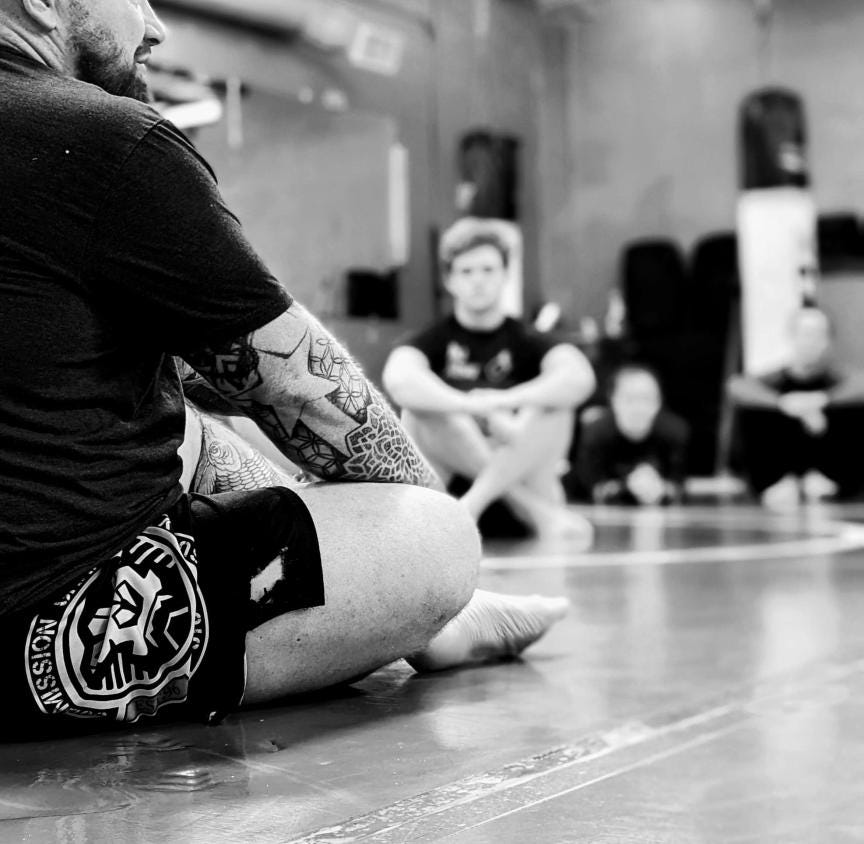
Attention to detail: Controlling the Back
A few key takeaways from last night’s nogi class.
As the attacker who already has control of your opponent’s back (in some variation of the chair-sit 4-point-hooks setup)
The preferred orientation of your spine to your opponent’s spine is parallel. Regardless of the mechanism you use to control their ability to move up/down or twist/turn, you want to keep your spine parallel to their spine. This is one of those neat orientation cues that, if all you do is make this your goal during a roll, you’ll be surprised how successful your control is. A secondary consequence of this orientation is that you will inevitably keep your sternum aligned between their shoulder blades. Either cue will serve as a useful orientation.
Consider decreasing your reliance upon the seatbelt (or any other grip setup) to control your opponent. Instead, use the top arm to control the shoulder via a pulling or isometric action, and the bottom arm controls in a similar fashion against the rib cage. The combined pull of these two limbs can create the same compression and rotational control while keeping your hands available to win the grip fight.
The control of their hips happens between your knees. Whatever hooks, grapevines, triangles, etc. that you choose for your feet are predicated upon keeping them between your knees. You must tenaciously maintain their body between your knees and immediately look to reset the position from side to side if they begin to clear your kneeline.
Class Move!
This move was presented as an option to recover your back control once they’ve cleared your bottom hook, but before they’ve turned in or recovered a guard/leg-entanglement.
Top hook is still in. Pull already lost bottom hook fully out and bring it behind you in a sort of “T” position perpendicular to their spine. Post your head on the mat behind their head (they’re still facing away from you because you still have a seatbelt grip or your sternum behind their top elbow). Tripod up and then punch your bottom leg up as high as you can alongside their back making a wedge very high on their back. Roll back 180 degrees so what was your top hook is now your bottom hook and re-insert your wedging leg as the new top hook.
A key detail that transfers from MATREP #2. As you roll 180 degrees during the final step, actively pull the person up off of the mat. This has multiple benefits. It keeps them from being able to slide down and out as easily. It makes your roll mechanically easier as you end up rocking from one hip/butt-cheek to the other. And, it keeps their elbows higher allowing your hooks to insert more smoothly.
A final thought. This move can be actively sought any time you have the triple-threat/tactical mount position (opponent is on their side facing away from you, you have any variation of head and arm control, one leg on either side of the body, the leg behind the back is wedging parallel to the spine, the leg in front is foot flat shin upright actively pulling the heel into their hip crease), either because you passed there on purpose or because your opponent attempted to escape mount and ended up there. I played this deliberately during rounds after class instead of seeking mount per my usual and it proved to be a very effective mechanism for opening up “clammy” opponents.
Personal Study Report: Room for improving my over-under
I forgot to pinch the leg. But, on the drive home, I realized I had forgotten, and noticing the missing detail is a win in itself. I’ve been told that when straddling the leg that you are “over” you must pinch the leg between your legs. Without this detail, the opponent has too much ability to hook and pummel and reorient (trust me I felt it first hand).
I had good success entering over-under from broken positions or scrambles. I think that having this as a key control option against opponents with dexterous guards will be invaluable.
A final positive. Because of the lack of collar grips, finishing over-under in nogi is an art. Right now, I’m finding that overdriving the leg once I’ve cleared both my legs to the same side is proving to be the most successful. This way I put them into a leg drag pass where I can patiently work my grips to the next control point. Requires less finesse.
A note on the leg drag. Thanks to Dan McCarthy at Memento, I’m working a new way of doing it where I stay on my toes, kinda like a “hack squat” with one shin on the opponents belly/side and the other under/behind their hamstring. This allows me to pinch and put weight on them at the same time, keeps me more upright and mobile, keeps my head away from their frames, and keeps my legside knee from going too deeply between their legs where it would be vulnerable to leg attacks via inversion, false reap, etc.
Lotta good grappling going on in my world right now.
Good Hunting,
Charles Batey