
MATREP #15, 2023MAR31
How much toughness is too much?

I think a lot about how to train my body to grapple well. The simple solution is get on the mat and get moving. For some people this can be enough. But as with any training, how you go about the task depends on what you’re trying to accomplish
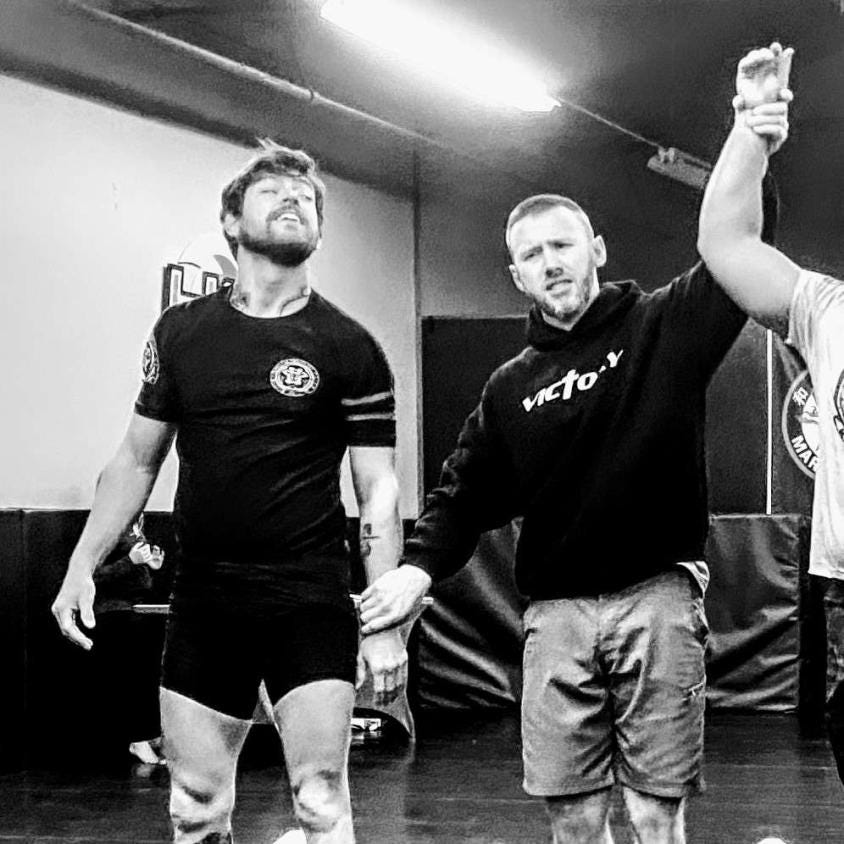
I have a goal to one day, when I am old, die on the mats.
I’m thinking that when the time comes, a really solid, booming judo throw ought to do it. Planet-punch my soul right into the next plane.
All fantasy aside, I do want to be involved with grappling, and with martial arts broadly, for the rest of my life. I’m no fool. I know that my game will have to change. And then, eventually what game I’m even playing will have to change.
But this goal of quality performance over the long haul is what motivates my training. At a fit 36, I am hoping to have at least ten or fifteen more years of hard charging performance in me where I can count on beating much younger men by being skilled, tough, patient, and applying my athletic power at the opportune time.
I think its the toughness that gets me in trouble though. I’ve spent a lot of time in the past few years developing my defensive abilities. It’s very gratifying to be so hard to submit that your opponent beats themselves through frustration and fatigue when they seem to always be “winning” but never able to finish. The downside of being a defensive specialist and a counter-attacker is you spend a lot of time just gritting your teeth through situations where a more sane person would have simply tapped.
So when I wake up sore, in weird ways that no amount of mobilization and increased bloodflow can quite shake. I ask myself, “Do all jiu jitsu players have this sort of pain?” It doesn’t really impair my quality of life. Though it does occasionally force me to play a different game than I would choose were one limb or another not tweaky at that moment.
But I ask myself, “Is this sustainable?”
My father loves to tell me that when I reach 40 I wont want to train any more, that the aches and pains will catch up with me and the sacrifice wont be worth the reward. He was a very competitive basketball player for long enough to be a multi-stripe black belt equivalent, so I trust his legitimacy as a source. But I’m stubborn and look forward to proving him wrong. Only, I don’t expect it’ll be easy.
What’s it going to take to stay strong and supple enough to be the oldest, meanest man on the mats?
The secret sauce is likely to be simple. Stay curious. Stay moving. Keep an open mind.
There’s a massive (and still rapidly growing) fitness industry that is trying to capture every corner of the “recovery” market right now. I don’t participate in it much as a consumer, at least in part for lack of funds. I’ve never been an “early adopter” anyway, doesn’t suit my temperament. But I’m glad to see all the various approaches being tested in the market place. Here in a few years, I’ll scoop up the ones that show themselves to have staying power.
I’m also a believer that the missing piece is rarely “more”. More information. More tools. More techniques. A shiny new bespoke gi. All of these things seem good on the surface, but surely you’ve heard some variation of the label “Jack of all trades —Master of none”.
It’s the same question I posed at the very beginning. “What are you training for?”
If you want to be great, remove the things that are in your way. Simple. Efficient. Way easier than scouring the earth for that “more” that you think you need in order to succeed.
…
This has meandered. Let me turn the question upon myself.
If I want to perform with high quality, for a long time, what should I remove from my existing patterns and practices?
I touched on it earlier. Toughness. Maximum toughness results in brittleness. You’re the toughest one on the mat until one day, when all the little cracks you’ve been ignoring finally amass sufficiently, you break.
Grappling is a tough game. We can’t give up our toughness completely. But we can modulate it. We can use it more wisely, more practically.
I’ll bring it all the way back to white belt days. Tap early, tap often.
Easy to say, harder to do.
I tapped early last night when my friend Mike was setting up a choke that had some very solid neck/spine twisting as a part of it. He hadn’t yet gotten to the part where he was applying the “finish”. We know each other well, I’ve been there before so many times and not tapped. When I tapped, he was surprised and confused. When I told him I needed to tap early because the pressure on my neck is too painful right now, he just nodded, the understanding and empathy were apparent in his eyes, he’s been there before. Nothing more needed to be said. No opinions of each other were altered. We slapped and bumped and got back to rolling.
Be tough, but not so tough that you break.
Set your own limits and regularly re-evaluate them.
Stay in the game.
Good Hunting,
Charles Batey