
MATREP #12, 2023MAR12
A surprising conditioning effect

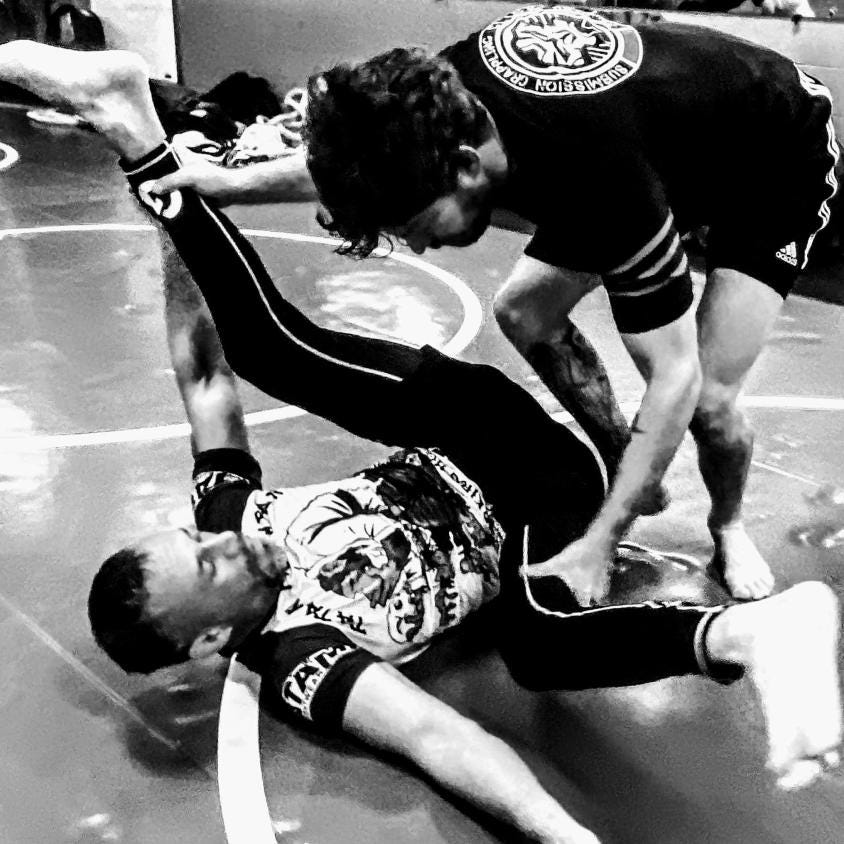
My training partners have been very considerate of me lately.
I really appreciate it. As I let my neck continue to heal, I’m playing a very truncated game. Just positional sparring from top, they start in open guard and aim to retain or sweep, I try to pass. I'm not passing under the legs (over under, double under, single under, duck under) to keep pressure off of my neck, and I’m still trying to not rely upon the knee cut, so lots of outside passing.
I’ve been doing this about a week and half now and I’ve realized something. Jiu jitsu makes a lot of us naturally lazy (myself included). We get into passed positions and then we rest. Even when we aren’t straight up holding just to catching our breath, once we make the pass we spend some time solidifying our gains, applying some tactical discomfort and from here on out the game slows down, a lot.
Its no secret that the key to a person’s ability to move athletically is in their hips, and more specifically, with their feet on the floor. So it makes sense that once we’ve passed a person’s legs, they’re going to be less athletic, and so I as the attacker don’t need to be as athletic to hold them down. The game slows down.
Well, that is not the case when you play full length rounds of open guard positional sparring. My training partners and I are consistently coming away from these rounds breathing harder than normal, and I’m even feeling some energy system hangover into the next round. I don’t typically voluntarily sit rounds out at open mat, but I’m finding that three 5-minute rounds are the sweet spot with this more cardiovascularly demanding training format.
This shouldn’t be news to me. There’s nothing novel about positional sparring. But especially at open mat, I’ve gotten into the habit of open rolling for fun. True, I do a lot of truncated training even within open rounds, stuff like only allowing myself certain submissions or certain grips or certain strategies, and this helps to keep my training focused. But if I pass quickly and then come up against a wall where the defender isn’t able to recover guard but does a really good job of avoiding limb isolation, I might spend 30 seconds passing and then 4.5 minutes maintaining a top pin. Sure, they’re gonna suffer, and we are both likely to breathe hard, but its a very different kind of round from 5 minutes of continual outside passing, for both the top and bottom player.
What to do with all this conditioning stimulus?
I worked as a personal trainer for about three years in my mid twenties. I was always really fascinated by training for specific qualities. Weight loss is kinda the big winner as far as marketing goes, but the real jewels within the industry have to to with using training protocols for specific adaptations.
The results of this positional sparring excite me in the same way that weightlifting programming used to.
I don’t drill as much as I used to 6 or 7 years ago. I pick things up faster now because I have a much richer context in which to place new moves. So I tend to just “drill live” by placing self-limiting constraints on my game. Perhaps I’ve been fooling myself. I’m thinking what I’ve been doing hasn’t been enough, that there is a lot to be gained from being even more focused in my training.
In MATREP #11, I wrote about using injury as a catalyst to grow your training. I guess I can add to that and say that injury doesn’t simple force you to grow, but it affords you insight that you’d otherwise not have taken the time to explore. I’ll have to think on this some more.

A quick miscellaneous list
Current leg lock of interest, the Z-lock
Turns out the setups I describe in MATREP #10 put you very close to z-lock territory so I’ve been playing with that. I, like many, had never heard of a z-lock until the most recent ADCC blasted it onto the scene. As interesting as it looked, I didn’t have viable entries to plug it into my game. Now I do. Hooray!
Deliberately passing in both directions right now.
It’s tough. And annoying. And frustrating.
I’ve gotten used to being “good” at jiu jitsu, and seeing myself as well-coordinated. Reality bites.
I now have two armbars!
As of maybe 6 months ago, if you had asked, I’d say I don’t really do armbars. I’ve got the classic closed guard one that I occasionally hit on white and blue belts, but I don’t actually play closed guard, so that doesn’t really count.
So I resolved to fix that and got my S-mount armbar really dialed in. I love that one because you’ve typically hammered the defender so badly that by the time you go for it they’re like “please just take my arm and stop crushing my rib cage”. Mean but fun.
But for the past two months I’ve been refining a power-half armbar that is so dynamic, it’s about to totally change how I’m attacking. For 2 or so years I’ve been focused on attacking pins and I’ve been preferring control over the sub, often forgoing available submissions in order to work on continuing my control skills. I like to think that all that time spent on solid control is opening the door for a new evolution into dynamic upper body attacks. Since I can control well, I can take the risk of the dynamic sub, knowing that if it fails I can just reassert my control. I’ll dig into the details on this submission another day.
Good Hunting,
Charles Batey